
What Happens in a Colour Analysis Consultation? | Ann Whitaker Style Brisbane
Have you been thinking about booking a colour analysis consultation, but you're not quite sure what to expect?
Maybe you've seen colour swatches on social media. Perhaps a friend mentioned having it done. You're curious, but you also want to know exactly what you're walking into before you commit.
That's completely understandable. In over 19 years of working with women across Brisbane, the Gold Coast, Sunshine Coast and beyond, some of the most common questions I receive are simply: What actually happens when I come to see you? How does it work? Is there anything I need to do beforehand or anything special I have to wear? Will ColourAnalysis be worth it?
This post answers all of it, by the time you finish reading, you'll know exactly what to expect, what you'll walk away with, and why this is one of the most practical investments a woman can make in herself.
This Is for You If...
•You keep buying clothes that look beautiful in the shop, then feel flat the moment you get them home
•You've noticed that certain colours seem to make you look tired or washed out, but you can't put your finger on why
•You're in your 40s or 50s and feel like what used to work just... doesn't anymore
•You're going through a change (menopause, a new career, divorce, retirement, or a new chapter) and you want to feel like yourself again
•You're done guessing, and you're ready for clarity
If any of that sounds familiar, you're in exactly the right place.
What You Will Know, Feel and Be Able to Do After Your Consultation
Before I walk you through the process, I want to be very clear about what this actually gives you, because it's far more than me giving you a list of colours to wear.
After your colour analysis consultation, you will:
KNOW:
•Your exact colour season and what it means and why it makes a difference
•Which specific shades within your season are truly exceptional on you, and which are simply average (yes that can happen - some shades in your season will be amazing and some will not be as great).
•Which lipstick shades, nail colours, blush shades and foundation tones harmonise with your natural colouring
•Which metals flatter you most (gold, silver, rose gold) and why
•How to approach hair colour: whether you're colouring, going grey or navigating the transition
•Which eyeglass frame colours support your palette
BE ABLE TO DO:
•Walk into any shop and know within seconds whether a colour is worth trying on
•Shop with a clear, personal framework, with no more guessing and no more second-guessing
•Build a wardrobe that works together, because everything starts from the same foundation
•Make simple, cost-effective adjustments to pieces you already own
FEEL:
•Confident getting dressed every single morning, not just for special occasions
•Clear and calm rather than overwhelmed when you open your wardrobe
•Like yourself, recognisable in photos, aligned in how you present and how you feel.
•Settled in the knowledge that you now have information you can use for the rest of your life
This is not about trends. It's not about rules. It's about giving you a personal framework that belongs to you.
Why So Many Women Feel Lost with Colour After 40
If you've been struggling with colour, I want you to know something: it is not a personal failing. It simply means you haven't had access to the right information yet.
This is one of the most common things women tell me. Not long ago I spoke with a woman in her 50s who had spent over three decades working in one industry before retraining into a new career. She had lost 12 kilos, was getting her hormones under control, and was ready to start putting herself out there again.
"I'm looking really tired and drab. I've moved away from wearing all black and now wear a lot of navy, but I want to add some colour and I don't know where to start. The problem is I keep buying the wrong shades. They look great in the shop, then I get home, see them in natural light, I think: that's just not right."
I hear this constantly from women across Brisbane, the Gold Coast and the Sunshine Coast and I heard it just as often when I was working in the UK, Tanzania and South Africa.
It's not a shopping problem. It's not a style problem. It's a colour information problem, and once you have the right information, everything shifts.
Why What You Wear at Home Matters More Than You Think
Something came up in that conversation that I always love to address: what we wear at home shapes how we feel about ourselves far more than most women realise.
She mentioned she only avoided unflattering colours when going out, and that wearing the wrong shades around the house was "fine."
I gently challenged her on this.
The way you feel when you look in the mirror on an ordinary morning affects how you carry yourself through the whole day. Your pyjamas, your weekend clothes, your around-the-house layers; all of it has an impact on how you see yourself, your mood and how you show up.
Comfort and colour are not in competition. You can feel completely at ease and still look wonderful, and more importantly, feel wonderful. The two have never been mutually exclusive.
What Actually Happens in a Colour Analysis Consultation, Step by Step
Here's the part many women are most curious about.
Before We Begin
When you arrive, we sit down together for a cuppa. This is not small talk, it matters, I want to understand what you're struggling with, what you've tried, and what you want to get out of our time together. I also walk you through the theory behind colour analysis so you understand what we're doing and why.
I'll ask you to arrive without makeup on. If you wear glasses, they come off for the initial draping process; once I'm clear on your result, I'll repeat the draping with your glasses in place if need be. Large earrings come off too.
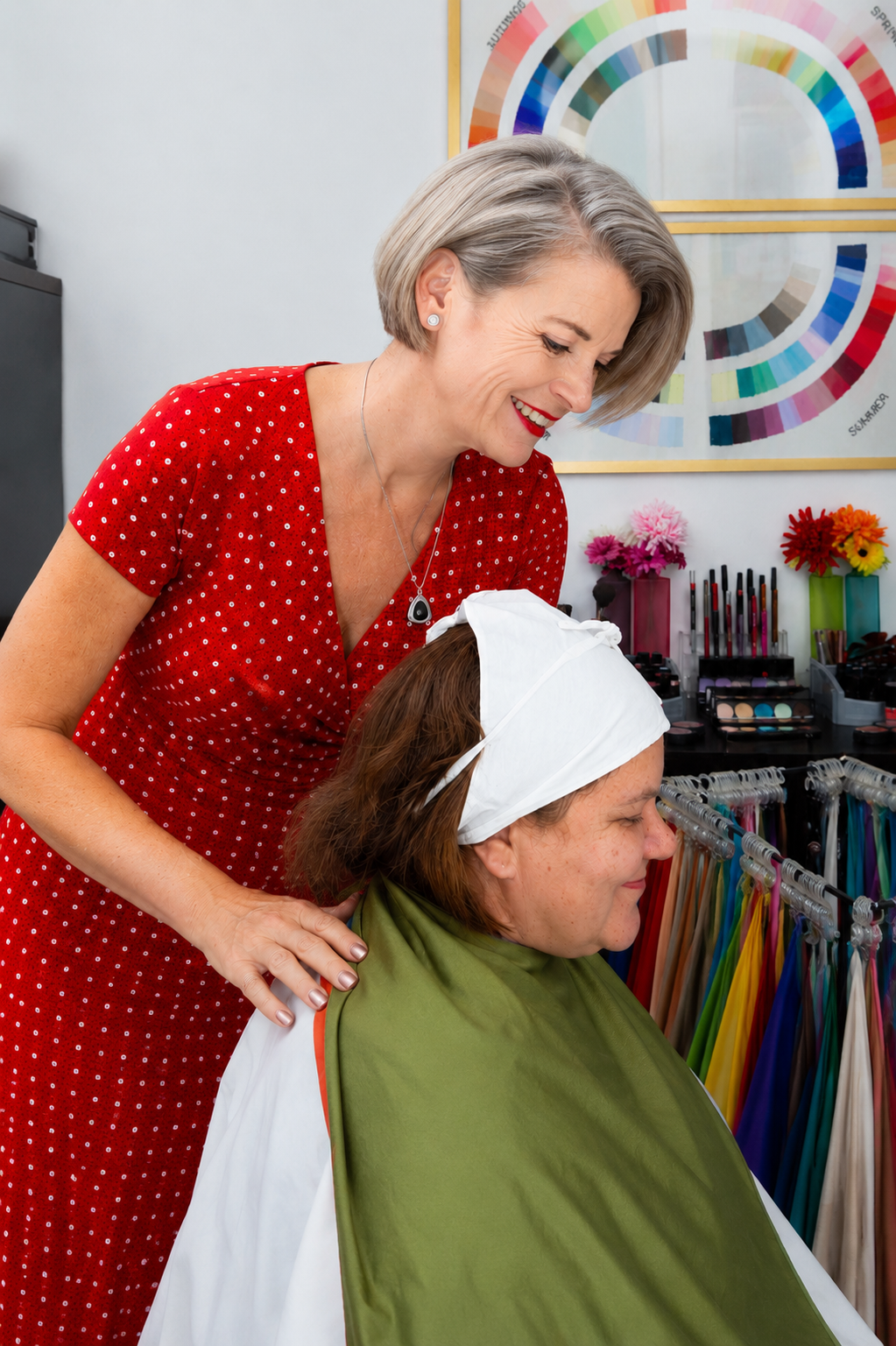
If your hair is coloured, I'll place a small white cover over it temporarily, just like the photo above. This removes the influence of any dye so we can read your natural colouring accurately, even if you believe your colour is close to your natural shade we will cover it at this stage, hair colour is a colour influence around your face and makes more difference than you might expect, once we know you season we will discuss hair colour options.
What you wear to the session doesn't matter at all. I'll cover you with a white hairdresser's cape, so come in whatever you're comfortable in: colour, pattern, anything you like.
The Draping Process
We move to the colour station, where I take your before photo. Throughout the session I'll take photos and videos; these are yours to keep afterwards as a personal reference. They are always kept private unless you give me permission to share them.
Then we begin the draping.
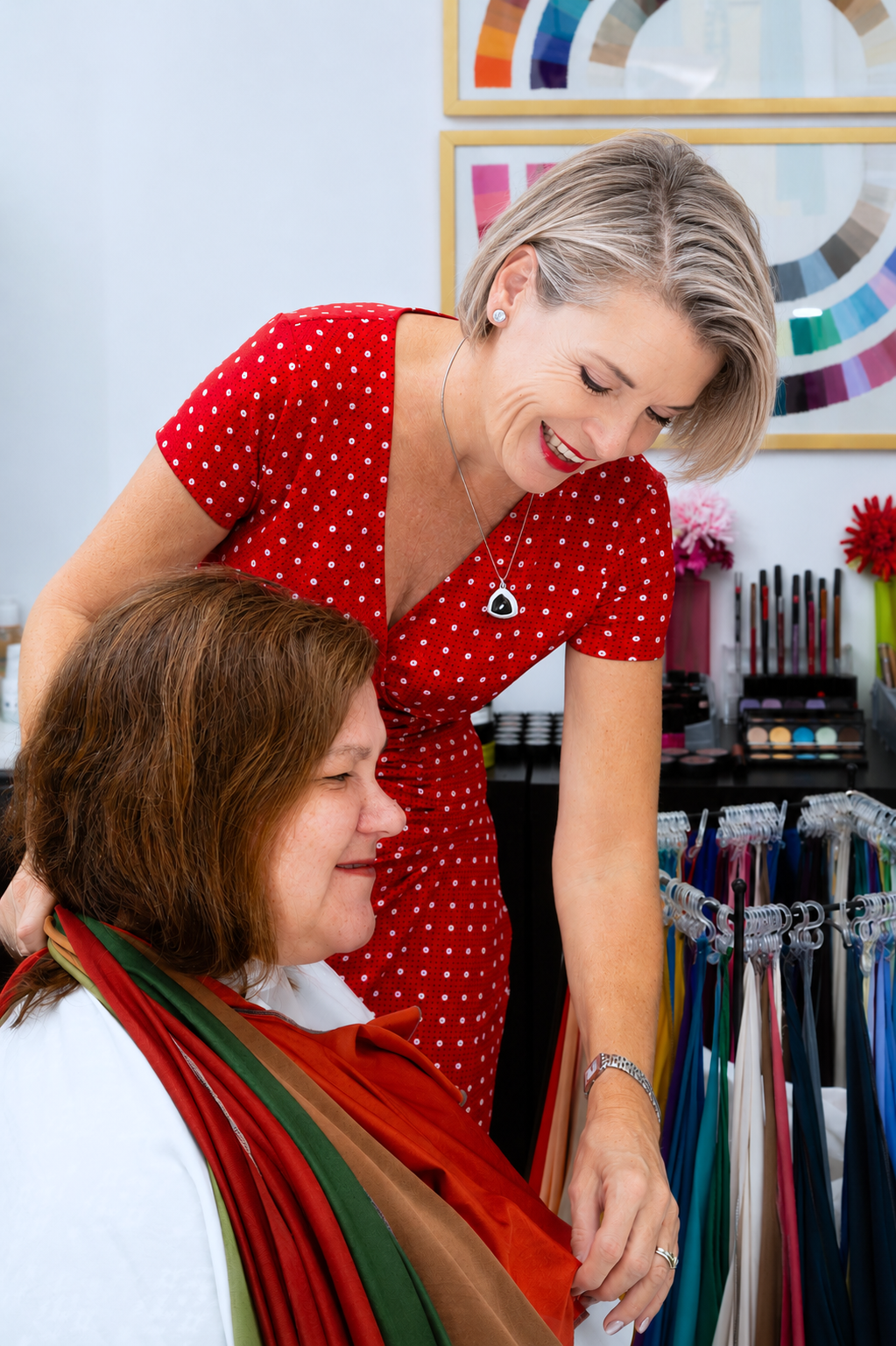
In front of natural light and a mirror, I hold a series of fabric samples (drapes) close to your face and neck. This is not a quiz. I won't ask you what colours you like or dislike, as that information would actually get in the way. My job is to find out what colours like you, not the other way around. We are watching how each colour responds with your skin in real time.
The difference a single shift in colour tone makes is something most women have never seen before. Sometimes it's clear almost instantly as we shift before colour tones, occasionally it takes a little more exploration. Either way, what you see surprises people every single time and I am still blown away by the difference colour makes to my client's faces even after 19 years as a colour consultant.
The reason you haven't noticed this before is simple: we all have biases. We're used to seeing ourselves in certain colours. We have colours we love and colours we dislike, and those preferences mean we cannot make an impartial decision about ourselves. Before my own analysis, I genuinely didn't like pinks or purples. They love me, and I've learnt to love what they do to my complexion and now they are a staple in my wardrobe. (Though I'm happy to report that doesn't always happen; sometimes the colours you already love do love you right back.) If it does and you don't love a particular colour and it loves you, that is OK, there will be lots of colours in your palette that you do like and you can focus on them instead.
Finding Your Season
The first thing we establish is whether you are warm-toned or cool-toned. Once that's clear, we narrow it further to determine whether you sit in the muted or brighter range. This is how we identify your season: Winter, Summer, Autumn or Spring.
Within that season, we also look at the highs and lows. Every season has some shades that are truly exceptional, and others that are simply average. We find the ones that genuinely lift you, and we discuss how best to use each shade practically within your own wardrobe., is it a dress, a top, a suit or is it better used just further away from your face like a skirt or trousers.
I also show you what an "off" colour does. Not to make you feel bad, but so you understand the contrast. Seeing an off-colour create shadows under the jawline, deepen dark circles or add years to your face is genuinely eye-opening. It's information. Once you have it, you cannot unsee it, and that's a gift and client's talk about that all the time.
What Your Colour Consultation Covers Beyond Clothing Colours
A colour consultation is not simply about choosing colours for your clothes. During our session we also discuss:
•Hair colour. Whether you're colouring your hair, going grey, or navigating the transition, your season and top colours informs the best approach. We go grey in the palette we were born with, your natural grey is actually working with your colouring, not against it. Whether you embrace it or continue colouring is entirely your decision, and either is completely valid.
•Jewellery. Which metals suit you best (gold, silver, rose gold) and how shade variations within those metals affect the result.
•Makeup. Which lipstick tones, blush shades and foundation shades will harmonise with your colouring rather than fight against it. We try on samples together, so we find the best shades specifically for you.
•Glasses. We discuss frame colours for glasses and sunglasses that support your palette rather than clash with it.
•Wardrobe strategy. This is not about throwing out everything you own, instead we discuss strategies to move forward with your new palette. If you already have pieces that aren't quite the right shade, we talk through practical ways to work with them. A scarf or a lipstick near the face can shift the balance considerably. Some clients even dye garments to bring them into their correct palette: a brilliant, budget-friendly option.
This is not about throwing away your wardrobe. It's about understanding what you have, knowing what to add, and shopping with clarity from here on.
Can You Trust What You Read Online About Colour Analysis?
This is an important question, and one that comes up regularly.
There is a great deal of conflicting advice online about colour analysis: which metals suit which seasons, which undertones correspond to which palettes, which quiz will tell you your season. Some of it is helpful. Much of it is oversimplified. Some of it is simply incorrect and extremely misleading.
Online quizzes, AI tools and self-assessments cannot accurately replicate what happens in person. Professional colour analysis requires watching how your skin responds to fabric in real, natural light. It involves subtle visual comparisons that cannot be captured through a screen, a set of tick boxes, or a photograph. The variables are too individual. Every woman I work with has nuances that no algorithm can account for.
What If I'm in the Middle of a Big Body Change?
This is one of the questions I receive most often from women navigating menopause, weight changes, or major life transitions.
Please don't wait.
Your colour season does not change with your body. The core principles we identify in your consultation will serve you at any size, through any transition. Colour is actually one of the most powerful and most accessible tools available to you during change, not after it. Starting with colour gives you an immediate, practical framework that will support you through the transition rather than waiting until "after", a finish line that rarely arrives in the way we expect.
What About Shopping Before a Consultation?
My answer is always the same: please do the consultation first, there is nothing worse that hearing a client has just bought something the week before out consultation in a colour that could have been a better choice for them.
It doesn't need to be an expensive shopping process to start making a real difference. Two or three pieces in your correct palette colours (even from an inexpensive shop) will do far more for how you look and feel than a full wardrobe in the wrong shades. Colour is one of the most powerful tools available to you, and one of the most cost-effective.
What My Clients Say
Here a few of my 115+ 5-star Google reviews from women across Brisbane, Gold Coast, Sunshine coast and beyond
What an experience! I booked a colour analysis with Ann and she blew me away. It was a very professional set up, and Ann talked me through the entire experience. She has a wonderful way with her words to describe the colours and what they do to your skin tone, appearance and especially the eyes. I would have never picked the colours that turned out to be good for me. I am looking forward to spend more time with Ann on my skin and wardrobe. Feeling good and highly recommend Ann's services.
Katya - Brisbane
Highly recommend booking Ann for a colour analysis. I had been interested in visiting Ann for some time but was confident I knew my best colours…this was until I sat in front of a mirror with Ann and realised I was completely wrong! The process is quite amazing and you will see the change in the mirror when you are draped in the right colour. Ann is so warm and friendly and a pleasure to work with. I’m very excited to use the knowledge I have learned to improve my current and future wardrobe, it makes shopping for the right pieces easier knowing they will work for me and work together.
Sandra- Brisbane
Ann was amazing, my daughter and I had an amazing experience getting to know our colours. We shop in a completely different way now. I highly recommend Ann to anyone who wants to get to know their colours, it will be a new beginning for you.
Heidi - Jimboomba
What an eye opening experience. I had my colour analysis done with Ann just over a week ago and since that time, I have been noticing colour everywhere. Ann patiently took me through the colour wheel and happily answered questions as she draped me in colour to show which colours best suited me. I walked away with my booklet and swatch and feel that I can confidently shop and narrow selections down to those colours that suit me. If anyone is thinking of having their colour analysis done, I would certainly recommend Ann. Thank you Ann!
Suzi - Brisbane
Key Takeaways
Feeling confused about colour is not a personal failure. It simply means you haven't yet had access to the right information.
What you wear at home shapes how you feel about yourself every day. Comfort and good colour choices are not in competition.
Professional colour analysis is a visual, real-time process that cannot be replicated by online quizzes or AI tools.
A colour consultation covers much more than fabric swatches. It includes hair, makeup, jewellery, nails, glasses, and practical wardrobe strategies.
Your colour season is information you will use for the rest of your life.
Frequently Asked Questions
Do I need to come without makeup?
Yes. Coming bare-faced allows the draping process to work accurately. We are reading your natural skin tone, so anything sitting on top of it will affect the result. I will apply a basic makeup look during your session (unless you prefer otherwise), so you'll leave looking lovely. Feel free to bring your own makeup along too for colour comparison.
What if I'm going grey or my hair colour has changed?
Hair dye is removed from the equation during the consultation by placing a white cap over your hair if it is coloured. Your current hair colour does not influence the result. We then discuss the best hair colour approach for your season as part of the session, including how to manage the transition to grey beautifully if you're ready to embrace that change.
I've been wearing black my whole life. Does that mean it's wrong for me?
Not necessarily. Black works beautifully for my Winters. What can happen as we age is that very high-contrast colours start to dominate or create shadows around the face, even in women they once suited. The consultation will show you clearly whether black is working for you; and if it isn't, we'll discuss other options and exactly what to do with the pieces you already own.
I'm in the middle of a significant body change. Should I wait?
No. The colour principles we identify in your consultation will serve you at any size. Your colour season does not change. Starting with colour now gives you clarity and confidence through the transition, not after it, If it is a significant change you will probably be buying some clothing anyway during the transition so these might as well be in colours that work best for you.
Can I do colour first and add styling later?
Absolutely. Some women will do exactly this, others will go full steam head and opt for the Full Day Colour & Style Experience., it is totally up to you. Starting with colour gives you an immediate, practical framework you can apply to shopping and dressing straight away. Style analysis can follow when you're ready, but colour should always come first.
Where are you located, and do you offer online consultations?
My studio in Kenmore, Brisbane, which is Brisbane West near Indooroopilly. I work with clients from across Brisbane, the Gold Coast and the Sunshine Coast and it is not unusual for people to travel inter-state to see me. At the moment I do not currently offer virtual colour consultations, as accurate colour analysis requires in-person assessment under natural light to produce a reliable result.
How is professional colour analysis different from an online quiz or AI tool?
Real colour analysis requires watching how your skin responds to fabric in person, under natural light. Online quizzes, AI tools and self-assessments cannot replicate this. They deal in generalised categories; professional colour analysis deals in you specifically: your unique combination of skin tone, eye colour, natural hair and undertone. In over 19 years of working with women, the difference between what an online quiz suggests and what an in-person analysis reveals can be significant, please don't base your wardrobe purchases on an AI generated report.
Ready to Find Out What Colours Truly Suit You?
Your colour season is not a fashion trend. It is based on your individual colouring, your skin, your eyes, your natural tone, and it is information you will carry with you for life.
When you know your colours, shopping becomes easier. Getting dressed in the morning feels lighter. You look at photographs of yourself and recognise the person you know yourself to be, rather than seeing something unexpected.
That clarity is available to you.
Book Your Personal Colour Consultation, the link is below
Still have some questions? Book in for a 20 minute Clarity call
What's your biggest challenge with colour right now? Share it in the comments. I'd love to hear from you.
Ann x


