
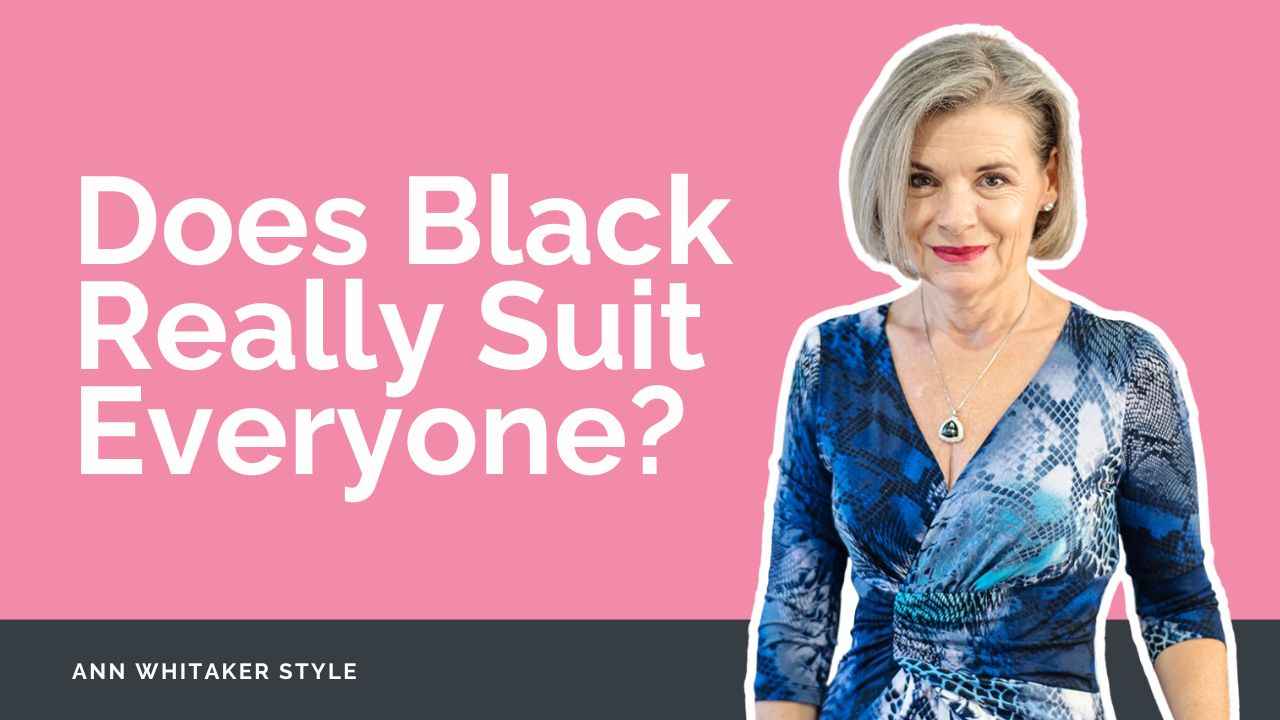
Does Black Really Suit Everyone? What 19 Years of Colour Analysis Reveals
Quick answer: No, black does not suit everyone. Whether it flatters you depends on your skin tone, undertone, contrast level and hair colour. Here is how to tell if black is working for you, and what to wear instead.
We have been brought up to believe that black suits everyone.
It doesn't. In fact, it's probably one of the biggest marketing ploys ever.
It is easy to understand why this idea became so widespread. Black is available in every shop, it hides stains, it photographs well. It (theoretically, more on that later) matches other things. It feels safe. It doesn't require you to think too hard, and for many women, black has simply become a default, a uniform, something they reach for without question.
In over 19 years of colour consultations, I can tell you with absolute certainty that black is one of the most common colours women are wearing to their detriment. Funnily enough, it's often the colour that people come to me going, "I know black is not working for me, but I don't know what else to do."
Why the 'Black Suits Everyone' Myth Exists
The 'black suits everyone' idea comes from the fashion industry, not from colour science. Black is easy to stock, easy to sell, easy to style. It became a shorthand for sophistication, and that shorthand became gospel. Let's face it: why would you produce a dress in 10 different colours, and take the risk some colours might not sell, when you can produce it in just black and tell everybody that it's going to suit them? Do you now understand why I believe it's the greatest marketing ploy ever?
Coco Chanel, the fashion influencer of her day, told everybody they needed a little black dress, and everyone believed her. It became fashionable, it became the "in" thing to wear.
The reality is more nuanced.
Whether black is flattering depends entirely on your individual colouring: your skin tone, undertone, contrast level, and hair colour. For some women, black near the face is genuinely stunning, I have clients where it is literally their best ever colour. For many others, though, it drains their natural colouring, dominates them, creates harsh shadows, and makes them look tired or unwell, even when they feel perfectly healthy.
I often hear "But I used to be able to wear black when I was younger" and it is quite probably true.
When we're younger, we have fresher, healthier-looking skin. We have fewer lines, fewer wrinkles, basically fewer signs of aging, so even if black isn't a top colour, we often can get away with wearing it quite successfully. It looks bold on us and will still be making us paler, but we're also more likely to put more makeup on: slap an extra bit of bronzer on, a little bit more blusher, a brighter lipstick, and away we go.
As we age that boldness becomes starkness and overwhelm occurs. Black can be quite harsh and aging, and since we generally wear less makeup than we did in our early 20's, that starkness becomes more evident.
What Happens When Black Doesn't Work for Your Colouring
When someone wears a colour that doesn't suit their natural colouring, the colour becomes the first thing you notice, not the person. The goal of good colour choice is the opposite: the colour should frame you, not compete with you.
For women with warm or light colouring, wearing black near the face can create a stark contrast that pulls attention away from their features. It can make the skin look sallow, the eyes look flat, or the complexion look uneven.
Many women compensate by applying more makeup, without ever realising that the issue isn't their skin. It's the colour they are wearing.
The Difference Between Safe and Flattering
This is one of the most important distinctions I make in consultations.
Safe means: predictable, available, unlikely to attract criticism, low-effort.
Flattering means: it makes your skin glow, your eyes stand out, and your features look clearer and more vibrant.
These are not the same thing. Something can feel completely safe while quietly working against you. Black, for many women, falls into exactly this category.
How to Tell If Black Is Working for You
Next time you wear black near your face, before you put your makeup on, look in the mirror in natural daylight and ask yourself:
Does my skin look vibrant and clear, or a little flat and tired?
Do my eyes look bright, or slightly dull?
Am I the first thing people notice, or is the black?
Do I feel the need for more concealer or blush than usual to compensate?
Does the colour dominate me?
Your skin tells the truth. These are your clues.
What to Wear Instead of Black
If black isn't serving you, the answer is rarely to abandon dark colours entirely, it's simply about finding your version of dark.
For some women that's charcoal, navy, deep teal, or chocolate brown. For others, it means wearing black away from the face rather than next to it, as trousers, shoes, or a bag rather than as a top or jacket. If you do have a top or jacket that is not working for you, then look at adding in a scarf, jewellery or lipstick to bring some brightness or lightness near your face.
The right alternative depends entirely on your individual colour palette, which is exactly what a professional colour consultation helps you discover, and we work out what your best solution is moving forward. Quick hint: it is NEVER ditch your black immediately, this is a process not a cull.
To Pull This Together
Contrary to popular belief, black does not suit everyone. We don't all need a black suit or a little black dress, and it is often not slimming either. It's a strong colour that suits some women beautifully and works against others, dominating their natural colouring and drawing attention away from them and to the item they are wearing. Understanding your personal colour palette is one of the most practical things you can do for your wardrobe. It removes the guesswork, saves you money, and means you show up looking like the best version of yourself, every single time.
You don't need to give up black forever. You simply need to know whether it's genuinely working for you and how to make it work best for you.
Want to discover your personal colour blueprint and find the shades that genuinely work for you? I'd love to help you find out.
Ann x


